
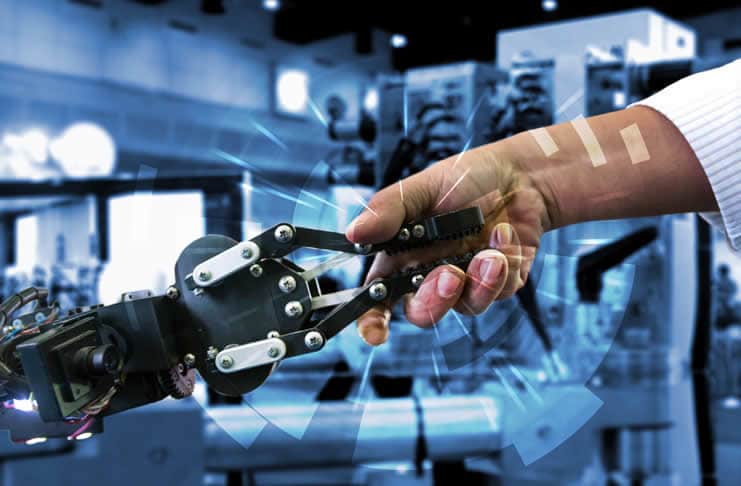

For the better part of a decade, public discourse around automation was trapped in a rigid binary: either artificial intelligence would hollow out the global workforce overnight, or it would remain an overhyped novelty confined to experimental sandboxes. Both perspectives missed the mark. The fundamental shift reshaping boardrooms, research institutions, and design studios is not wholesale human replacement, but an unprecedented convergence of computational velocity and human discernment.
The organizations pulling ahead are not pursuing total automation. Instead, they are dismantling the friction between analytical processing power and contextual experience. By pairing digital speed with human wisdom, forward-thinking enterprises are turning traditional workflows into a continuous, high-velocity dialogue. This evolution marks a decisive transition from software as a passive utility to technology as an active collaborator.
Moving Past Replacement to a Deliberate Division of Labor
The central flaw of early enterprise automation strategies was treating software as a one-to-one substitute for personnel. Sustainable efficiency rarely comes from cutting people out of the loop; it emerges when organizations reconfigure workflows so both parties operate strictly at the top of their capabilities.
Machines excel at tasks that quickly overwhelm human biology: processing millions of unstructured data points, mapping subtle statistical anomalies, simulating thousands of operational scenarios simultaneously, and generating baseline drafts in seconds. What they completely lack is an understanding of real-world context, organizational culture, moral responsibility, and strategic intent.
When enterprises implement a true cognitive division of labor, productivity scales exponentially. A pharmaceutical researcher no longer spends months manually screening molecular structures; an algorithm screens and surfaces the fifty most viable candidates in an afternoon. From there, the human scientist evaluates biological feasibility, toxicological trade-offs, and clinical study designs. The machine compresses the exploratory phase from quarters into hours, leaving the interpretative, high-stakes decisions to human expertise.
Accelerating the Innovation Cycle Across Knowledge Work
Traditional innovation was bound by linear execution. Developing a comprehensive marketing strategy, building an enterprise software suite, or designing an industrial component meant moving through rigid cycles of drafting, stakeholder review, manual adjustment, and delayed rollout.
Human-machine collaboration breaks this bottleneck through rapid generative prototyping. Rather than beginning with a blank canvas and moving through static revisions, professionals now use intelligent systems to generate multi-variable options, stress-test logic, and build functional prototypes on demand.
From Linear Planning to Continuous Iteration
This continuous back-and-forth fundamentally changes how teams solve complex problems. In software engineering, developers utilize code-generation assistants not to abdicate architectural responsibility, but to eliminate routine boilerplate syntax, surface security vulnerabilities, and generate regression tests. This frees senior engineers to concentrate on system resilience, modularity, and end-user performance.
In executive suites, leadership teams can evaluate corporate projections against hundreds of localized economic shocks in real time. Strategic planning ceases to be an annual guessing game based on static spreadsheets. It becomes a responsive conversation where human leaders establish the constraints, the system models the probabilities, and the leaders weigh the strategic risk.
The Rising Value of Human Discernment and Context
An interesting paradox of the modern workplace is that as computational capability becomes abundant and inexpensive, uniquely human traits become exponentially more valuable. When generating text, software code, or financial summaries costs virtually nothing, sheer volume ceases to be a competitive advantage. The true bottleneck shifts to critical discernment, taste, and contextual judgment.
Algorithms can assemble information with remarkable coherence, but they cannot evaluate whether a technically viable proposal aligns with a company’s core mission or cultural identity. They cannot read emotional nuances in a high-stakes negotiation, build genuine trust with a distressed client, or foresee the public-relations fallout of an ethically dubious product feature.
As mechanical execution becomes commoditized, leading organizations are deliberately elevating capabilities that technology cannot imitate:
-
Strategic Synthesis: The ability to connect unrelated concepts from disparate industries to pioneer original business models.
-
Empathetic Leadership: Managing organizational fatigue, navigating workplace ambiguity, and creating psychological safety for creative risk-taking.
-
Ethical Stewardship: Scrutinizing automated recommendations, uncovering latent historical bias in datasets, and ensuring operational choices remain socially accountable.
Professionals who pair deep domain knowledge with an instinct for critical interrogation will thrive. Those who rely solely on following established procedural scripts will find their roles diminished.
Establishing Guardrails Against Automation Bias
Adopting collaborative digital systems without clear operational safeguards introduces severe organizational risks. The most insidious threat is not that algorithms will behave maliciously, but that human operators will surrender their natural skepticism.
This vulnerability, known as automation bias, occurs when professionals assume an output is inherently accurate simply because it was calculated by a complex algorithm. In reality, predictive models can hallucinate plausible untruths, amplify blind spots present in their training parameters, and mishandle rare edge cases with unwarranted confidence.
Building a dependable collaborative framework requires intentional friction. Systems must be designed with transparent audit trails, verifiable data sources, and strict human-in-the-loop validation checkpoints. An organization that outsources institutional judgment to autonomous software without rigorous manual oversight creates brittle foundations that invite systemic failure.
Preparing the Workforce for Co-Piloted Systems
Operating alongside sophisticated digital assistants demands a significant shift in corporate training, talent acquisition, and professional development. For generations, professional training rewarded memorization, mechanical compliance, and strict adherence to established rules. Those capabilities are precisely what machines perform most effectively.
Progressive companies are prioritizing systems literacy, cognitive agility, and inquiry-driven communication. The modern professional must know how to frame ambiguous commercial problems into structured operational queries, cross-examine automated outputs, and weave fragmented digital insights into cohesive solutions.
This evolution does not require every professional to become a software engineer. Rather, it demands that employees across finance, legal, human resources, and operations understand how computational tools function, where their limitations lie, and how to harness them to amplify their own professional expertise.
The future of work will not belong to unaided humans working with outdated manual tools, nor will it belong to fully autonomous software running without supervision. The real breakthroughs belong to organizations that master the partnership between both. When machines shoulder the computational weight and humans steer the ship with purpose and judgment, innovation transforms from an occasional stroke of luck into a sustainable daily advantage.

Comments are closed.