
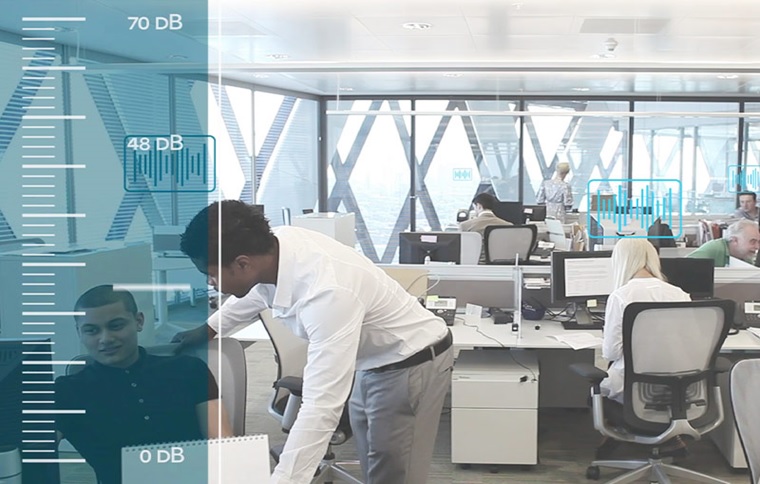

The use of specially adjusted atmospheric noise to particular frequencies is known as sound masking. For more privacy, it prevents speech from being understood. It produces resonances behind you that aren’t obtrusive.
It might even make your space seem calmer. It can lessen workplace distractions and safeguard the privacy of discussions.
This enables employees to block out external distractions. They can therefore pay closer attention to the task at hand with sound masking.
It differs from white noise, which could cause ear irritation. Instead, it’s meticulously adjusted to synchronize with human vocal resonances during muffled conversations across great distances. Fortunately, marketplaces offer a variety of products and techniques. These might successfully mask the audio.
What’s Sound Masking?
You’ll significantly reduce how noticeable discussions are. This would generally reroute anyone more than 15 feet distant. Thus, enhancing speech privacy systems is always a workplace issue.
Thus, face-to-face collaboration between colleagues remains unaltered. Distant conversations disappear into the background, safeguarding the confidentiality of exchanges. Installers are experts in their fields. They specialize in sound absorption and masking technologies.
There are two primary domains in audio masking:
- Indirect
An indirect installation would be an extra option for this. There’s a drop ceiling over the speakers.
The direction of the ear-generated interference is upward. Consequently, they land back in their local surroundings after bouncing off your ceiling deck.
- Direct
From a direct field perspective, this technology’s installation is conceivable. With your ceiling speakers aimed downward. Your office is instantly filled with unbridled auditory privacy. This method aids in producing an audio field that’s uniformly distributed.
What’s Speech Privacy?
It describes the ability of an inadvertent listener to comprehend what is being said to them. Sometimes, personnel may not even realize that communications are difficult or unclear to understand. It just disappears into the room.
Simple, intelligible dialogue becomes grating. Chats that you listen in on disrupt your inner thinking. Concentration is extremely difficult as a result.

Sound Masking: Technical Element
The voice frequencies that make up human speech range from 80 to 300 Hz. Go to https://physics.stackexchange.com/questions/76463/what-is-the-meaning-of-frequency-of-a-human-voice for further reading. Harmonics is another aspect of communication that may improve understanding and lucidity.
The softer audio is muffled by a louder one that’s on the same wavelength. This could come up in loud dining establishments or when we try to converse while riding. We have a tougher time finding the information we’re seeking because of background noises.
The system produces noises in this case. It’s at the same frequency as talking, which is between 200 and 4,000 Hz. As a result of the new information. Our brains have a harder time differentiating between the subtleties of conversations that are happening close by.
Installation
This system usually uses several loudspeakers. They are inserted into or dropped from the ceiling. It creates a lively backdrop by utilizing a frequency curve. As a result, outside speech is incomprehensible.
The frequencies that the technology employs are adjusted to match human speech. Conversations taking place no less than fifteen feet away will be hidden by this. It doesn’t obstruct in-person discussions in this manner.
It may contribute to the pandemonium, but it may also create the impression that the area is more subdued and peaceful. Reducing the amount of annoying speech is aided by increased audio. The volume adjustment frequency for this system is typically 40 to 48 decibels.
When does Sound Masking become necessary?
A big office space usually has a rating of fifty decibels. This can draw employees’ attention away. They thus find it difficult to focus on their work.
Some workers choose to utilize noise-canceling headphones to remain concentrated and productive. This is something that several HR experts advise doing. But when every worker is glued to their smartphone, the advantages of a shared office are gone.
When employees can’t hear each other, how can they work together? The office may be overly noisy even if your employees don’t have many things on their desks.
Is it beneficial?
By lessening a portion of the disturbance. Acoustic disturbances can produce a specific type of noise. That might be beneficial in the surroundings.
Eliminating possible interruptions from remote discussions can enhance worker productivity. Consequently, it becomes harder to distinguish terms in a conversation. This might facilitate the fading of background noise.
It also keeps prying eyes away from intimate chats. A less disruptive radius could make the space appear more peaceful.
Does it always work as it should?
Noisy workspaces and open design elements are standard. However, easy fixes aren’t always available. Studies demonstrate how important it is for business leaders to ask for and value employee feedback.
Researchers carried out a study in 2020. They conducted interviews with bakery employees to learn about their feelings and experiences with noise pollution. Here is a useful source for more info.
After the device was placed, they were required to suffer for fourteen weeks. Employees stated that productivity and stress levels had not dropped. Such a framework irritated a few of them. This could therefore result in less productive work being done.
However, in another investigation that was released in 2017, researchers swapped out the conventional sound system. It belongs to the individual who creates noises that reflect the environment. The employees preferred the previous method and thought that natural sounds were extremely distracting.
Applications
These are specifically created for particular regions and are intended to function in those circumstances. Usually, this entails using speakers that are specifically installed in or above a workstation’s ceiling. They are either straight down or inclined downward.
Usually, this system will include the following sections and components:
- Random electrical impulses come from sources of noise.
- To adjust the electrical impulses to the proper frequency, use an equalizer.
- Strong amplifiers are also used to boost the loudness levels.
- The audio broadcast will be appropriately regulated by controllers.
- Make use of high-quality speakers to fully enjoy these audio files.
- PCs and electronic devices can benefit from software applications that improve system control.
For smaller settings, there are stationary objects and equivalents available. Conversely, experts usually set up and maintain a system. An administrator will be able to access the system upon installation.

Comments are closed.