

Introduction
The smartphone industry is no longer driven purely by faster processors, higher refresh rates, or camera megapixels. A silent transformation is reshaping mobile technology: Mobile Edge AI. This convergence of on-device intelligence and edge computing is redefining what smartphones can do, taking them far beyond mere communication tools. As we move deeper into the 5G and upcoming 6G era, Mobile Edge AI is becoming the foundation for the next wave of hyper-personalized, real-time, and adaptive mobile experiences.
What Exactly Is Mobile Edge AI?
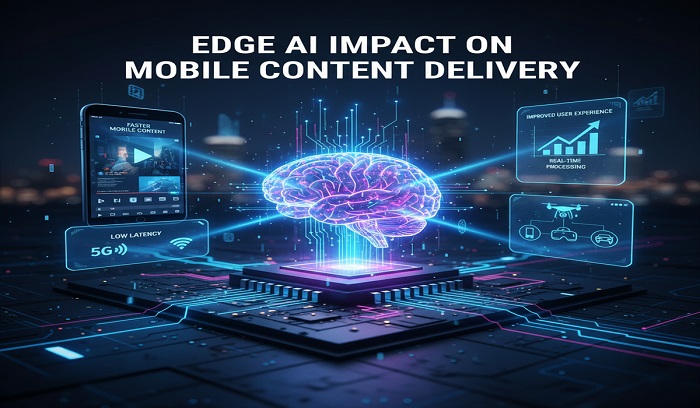
Mobile Edge AI is the integration of on-device artificial intelligence with mobile edge computing. It allows complex data processing and decision-making to happen closer to the user—either directly on the smartphone or through edge servers located near the device rather than in distant cloud data centers. This results in instantaneous responses, reduced latency, and enhanced privacy.
The Core Components
On-Device AI: Modern smartphones are equipped with neural processing units (NPUs) capable of handling deep learning models locally. Tasks like natural language processing, image recognition, and predictive analytics can now be executed without cloud dependency.
Mobile Edge Computing (MEC): This network architecture moves computing resources closer to end-users. It bridges the gap between device and cloud, providing ultra-low latency for real-time applications like augmented reality, intelligent gaming, and predictive maintenance.
Why It Matters
Unlike cloud-only systems, Mobile Edge AI offers:
-
Reduced Latency: Responses are nearly instantaneous, enabling real-time analytics and immersive applications.
-
Enhanced Privacy: Data remains on or near the device, minimizing exposure.
-
Improved Efficiency: Bandwidth and power usage are optimized by reducing unnecessary data transmission.
The Evolution of Smartphone Intelligence
Traditional smartphones rely on cloud-based AI to perform resource-intensive tasks. However, that approach introduces delays and privacy risks. Mobile Edge AI reverses that dependency by empowering the device to act as an intelligent agent rather than a passive endpoint.
This evolution allows smartphones to function as real-time decision-making tools—capable of understanding context, predicting user intent, and collaborating seamlessly with connected devices. It marks a decisive shift from reactive computing to proactive intelligence.
Key Transformations Driven by Mobile Edge AI
1. Real-Time Contextual Awareness
Modern AI on smartphones goes beyond simple automation. With edge computing, devices can interpret multi-sensor inputs—location, sound, temperature, motion—and act intelligently without user prompts. Imagine a phone that automatically switches to meeting mode when it senses a conference room environment or adjusts display brightness based on your activity pattern.
These real-time adaptations are made possible because decision-making happens directly on the device or through nearby edge servers. The result is a faster, more responsive digital companion that truly understands the user’s context.
2. Next-Gen AR and VR Experiences
Augmented and virtual reality demand immense processing power and ultra-low latency. Mobile Edge AI provides the missing link that allows smartphones to deliver seamless AR/VR experiences. Applications like interactive education, virtual retail try-ons, and real-time navigation overlays become smoother and more realistic when rendering tasks are handled at the edge.
Instead of waiting for cloud responses, edge nodes process spatial data, enabling fluid interactions. This evolution could transform smartphones into AR command centers—making advanced visualization accessible to millions without external hardware.
3. Smart Integration with IoT and Wearables
Mobile Edge AI empowers smartphones to act as the central hub of personal and industrial IoT ecosystems. Devices can now analyze inputs from wearables, sensors, and smart appliances to create a coordinated environment.
For instance:
-
Your smartwatch detects a spike in heart rate; your phone instantly suggests a breathing exercise or notifies your healthcare provider.
-
Entering your car, your smartphone preloads your route data and syncs preferences via the edge network.
This fusion of mobile intelligence and edge computing makes IoT ecosystems more autonomous and adaptive.
4. Personalized Predictive Intelligence
AI-driven personalization is moving beyond content recommendations. Mobile Edge AI enables predictive actions based on behavioral, contextual, and environmental cues.
Your smartphone can learn your work routine, anticipate your app usage, or even optimize CPU and battery performance based on past behavior. The combination of local data processing and edge synchronization allows for a more privacy-conscious yet deeply personalized experience.
This adaptive intelligence is the foundation for emotion-aware interfaces, predictive camera modes, and voice assistants that evolve with your habits instead of static programming.
5. Reimagining Device Design and Hardware
Hardware evolution is following software intelligence. Smartphone manufacturers are optimizing architecture for AI-driven workloads by integrating:
-
Dedicated NPUs and Tensor Cores for accelerated neural processing
-
Thermal-efficient designs to handle sustained AI computation
-
Modular chipsets that dynamically offload workloads to the edge network
Foldable and dual-screen designs are particularly well-suited for multi-tasking AI functions—like simultaneous translation, editing, and media analysis—making form factor a part of the AI evolution itself.
6. Enterprise-Level Edge AI on Mobile
For enterprises, Mobile Edge AI brings real-time insights to frontline workers. Field engineers can use AR overlays to troubleshoot equipment while the AI engine processes sensor data locally for faster decisions. Retail, logistics, and healthcare sectors are already exploring AI-at-the-edge mobility to improve operational responsiveness and reduce downtime.
Challenges in Scaling Mobile Edge AI
Power and Heat Management
Running AI workloads locally demands high energy consumption. Managing battery life and thermal output without compromising performance remains a significant challenge. Hardware manufacturers are tackling this with adaptive power management systems and AI-based workload scheduling.
Standardization and Interoperability
For edge AI to thrive, global standards must align network protocols, edge infrastructure, and AI frameworks. Without unified architecture, interoperability between devices and networks could hinder scalability.
Data Privacy and Security
While edge AI enhances data control, it introduces new attack vectors. Securing distributed networks and ensuring encrypted communication between devices, edge nodes, and the cloud is essential for maintaining user trust.
The Future: Convergence of Edge AI and 6G
As 6G research accelerates, the synergy between next-gen networks and edge AI will define the smartphone’s future. Devices will no longer depend solely on app ecosystems; they’ll function as autonomous digital agents capable of self-optimization and real-world awareness.
We’ll see AI models that adapt in real time based on environmental changes, holographic communication becoming mainstream, and phones integrating directly with decentralized edge nodes for seamless computing continuity. Mobile technology will cease being about screens—it will evolve into an ambient layer of intelligence surrounding every user.
Conclusion
Mobile Edge AI is more than an incremental improvement—it’s a structural transformation of mobile technology. By bringing intelligence closer to the user and distributing computation intelligently across the network, smartphones are becoming proactive, predictive, and context-aware. As hardware, software, and networks continue to merge, the boundary between human intent and machine execution will fade, ushering in a new era of intelligent mobility.
FAQs
1. How does Mobile Edge AI differ from cloud AI?
Cloud AI relies on remote servers for computation, while Mobile Edge AI processes data on-device or through nearby edge servers, reducing latency and improving privacy.
2. Will Mobile Edge AI make smartphones more expensive?
Initially, yes—due to advanced chipsets and infrastructure integration. However, economies of scale and optimized architectures will gradually lower costs.
3. Is Mobile Edge AI limited to high-end smartphones?
Not for long. Mid-range devices are already integrating simplified NPUs and 5G connectivity that enable partial edge-based intelligence.
4. How does Mobile Edge AI improve mobile gaming?
By minimizing latency and offloading rendering tasks to edge servers, it ensures smoother gameplay, real-time physics, and cloud-like performance without overheating the device.
5. What role will 6G play in advancing edge AI?
6G networks will provide ultra-low latency and intelligent connectivity, allowing mobile devices to offload complex AI tasks seamlessly while maintaining real-time interactivity.
6. Can Mobile Edge AI operate offline?
Yes, many AI tasks—like image processing, language translation, and predictive text—can run entirely offline using local models stored on the device.
7. What industries benefit most from Mobile Edge AI?
Healthcare, logistics, retail, and industrial maintenance are early adopters, using edge-enabled mobile AI to deliver real-time insights and automated decision-making in the field.

Comments are closed.